North American Aviation P-51 Mustang Fine Art Aircraft Prints
Perhaps history's most iconic and recognizable fighter, the Mustang's speed, range, and firepower turned the tide of the American daylight bombing campaign during WWII and paved the way for victory in the European Theater of Operations. Operated by 27 different nations, the Mustang was the standard for more than a decade.


Images are reduced fidelity for copyright protection.
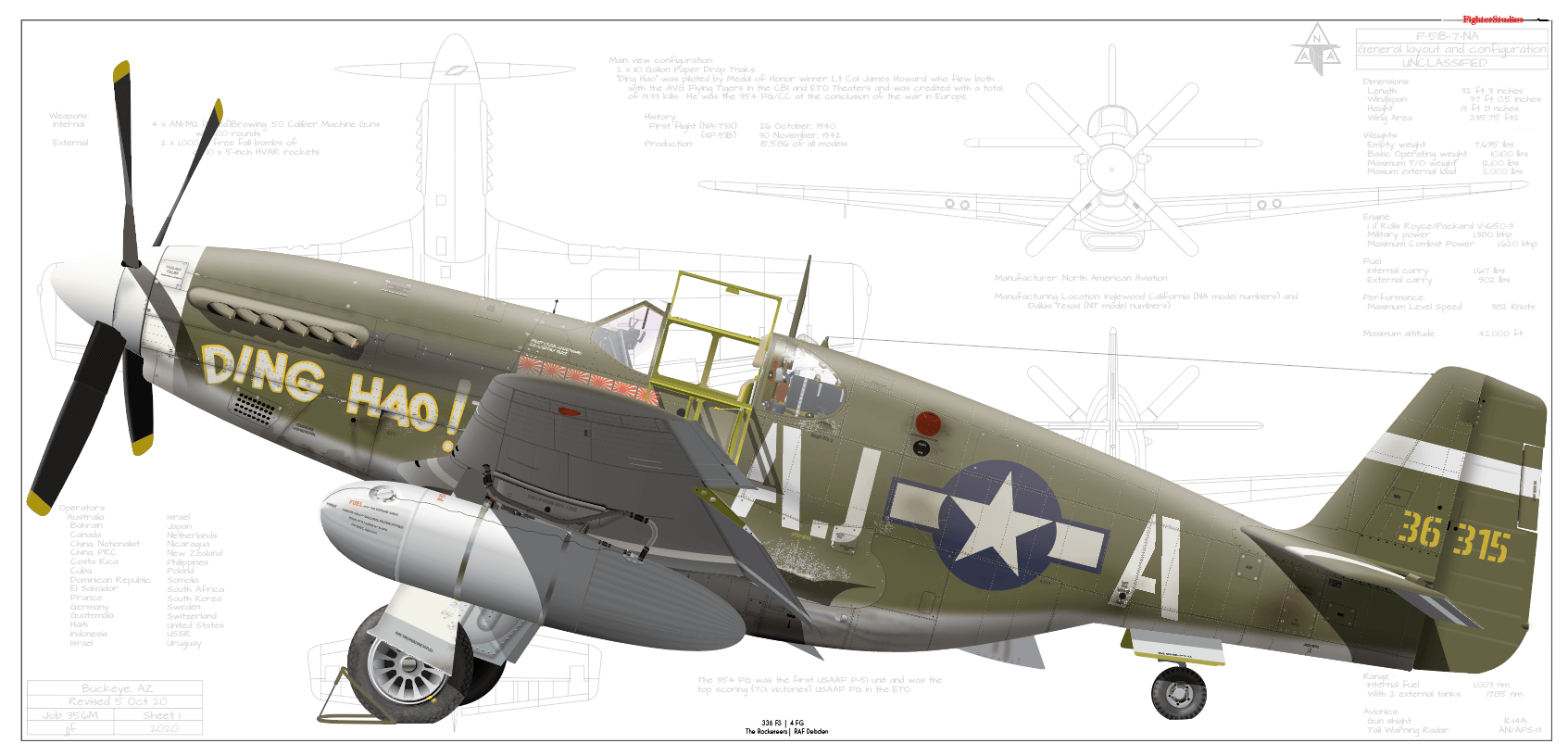
A quantum performance leap from its predecessors, the P-51B was the first Merlin powered Mustang. The B’s had an extra fuel tank which greatly increased their range and the Merlin performed far better at altitude. The USAAF finally had the long-range escort fighter it needed
The first Mustang unit in the ETO was the 354 FG which was, coincidentally, also the highest scoring FG in the ETO with 701 victories. Their first long range escort mission occurred on 11 January, 1944 and was quite noteworthy. On that mission, AJ+J was piloted by Maj James Howard, then the 354 FG commander, and with her, he earned the only Congressional Medal of Honor awarded to an ETO fighter pilot.
Howard's group was to rendezvous a formation of over 500 US bombers as they egressed a target west of Berlin and protect them until relieved by another unit closer to England. With an estimated 500 total German fighters mixed up with the bombers, Howard took his group towards the lead section of 25 bombers defending themselves from 30-40 German fighters.After quickly engaging three and downing two enemy fighters, Howard realized he was separated from his flight that was flowing to the rear bomber formation. He began to flow there as well when he realized the lead bombers were still heavily engaged and without any escort. Howard turned, single handedly, back towards the lead group. He engaged and remained engaged with enemy fighters for 30 minutes protecting the bombers even after all three of his four guns had jammed. He was credited with 4 victories that day.
Howard’s Mustang is shown ready for another mission with a pair of 110 gallon “paper” external wing tanks and her 4 x .50 caliber machine guns.
Any Fighter Studios print can be customized with different squadron marking, different store configurations, names on the nose or canopy rail. To get yours started, click Personalized Print for more information or click Email with questions.


Images are reduced fidelity for copyright protection.
This original digital artwork depicts a US Army Air Corps from the 318 Fighter Squadron, 325 Fighter Group in the European Theater of Operations during World War 2. On 14 March 1945, this plane was the mount for Lt Gordon "Mac" McDaniel when he became an "ace in a day" downing 5 German FW190. Mary Mac was lost just over a month later when another pilot was lost during a single ship strafing mission against Axis rail traffic.
Any Fighter Studios print can be customized with different squadron marking, different store configurations, names on the nose or canopy rail. To get yours started, click Personalized Print for more information or click Email with questions.


Images are reduced fidelity for copyright protection.
The most recognizable Mustang is the P-51D with its bubble canopy… in fact, over half of all Mustang’s built were D’s. Beyond the cut down rear fuselage and bubble canopy, the D-model was significantly changed from the B’s and C’s that preceded it.
The D’s windscreen was simplified to provide better visibility. The wings were significantly redesigned featuring a deeper chord –allowing the 50-caliber machine guns to be mounted vertically providing room to increase the armament to 6 guns – and a small leading edge extension at the root was incorporated to house an updated landing gear system.
The engine was the same as in the B/C version which – combined with the deeper chord wing and higher drag canopy design – resulted in a slightly reduced maximum level flight speed and service ceiling… given the increased firepower and visibility, it was overall a welcome trade off.
The D’s kept the B/C model 85-gallon fuselage fuel tank behind the pilot’s seat, and inherited the same slow speed snap roll tendency of the Razorback’s. Additionally, the reduced fuselage side area (keel, if you will) created a yaw stability problem for the bubble canopy planes. To help with both issues, a design change incorporating a leading edge extension to the base of the vertical stabilizer was introduced in summer 1944. All planes manufactured prior to the change we retrofitted in the field.
Some external lighting updates were introduced as well as a new gun sight and a tail warning radar system was fitted.
The red/yellow spinner stripes and checkerboard pattern on the nose in this original digital artwork indicate this plane 357th Fighter Group that operated out of RAF Leiston in south east England during WWII, and the G4 fuselage code identifies this as a 362 Fighter Squadron plane. These 8th Air Force units were among the “Little Friends” that escorted heavy bombers on their missions over Europe.
Plane “E” belonged to ace Capt John England was credited with 17.5 victories by war’s end. He was also the Squadron Commander and among his decorations were a Silver Star and multiple Distinguished Flying Crosses and Air Medals. Following the war, then Major England transitioned to the newly formed US Air Force flying in the US and briefly during the Korea Conflict.
After transitioning to the F-86, then Lt Col England was involved in a landing accident in France in 1954. Faced with ejecting or maintaining control of the jet to prevent it from crashing into barracks on the base, England chose the latter which cost him his life. For his gallant actions, England AFB in Louisiana was named in his honor.
Any Fighter Studios print can be customized with different squadron marking, different store configurations, names on the nose or canopy rail. To get yours started, click Personalized Print for more information or click Email with questions.


Images are reduced fidelity for copyright protection.
“Shangri La" was the personal mount of WWII ace Capt Dominic "Don" Gentile credited with 25.83 kills and 3 damaged enemy aircraft. Known as "Captain Courageous," he and his wingman John Godfrey were jointly "The Two Man Air Force," and Damon and Pythias... they combined for 44 victories.
With her exhaust covers removed for improved cooling and gun ports covered with tape to prevent freezing, she is shown with 18 of Gentile's eventual total and the early red and white spinner. Like many B/C's, Gentile elected to have the fixed "ring and bead" gun sight in addition to the newer projection sight. She carries her bright red MLG wheels and the large "Boxing Cock" logo the plane became well known for.
Any Fighter Studios print can be customized with different squadron marking, different store configurations, names on the nose or canopy rail. To get yours started, click Personalized Print for more information or click Email with questions.


Images are reduced fidelity for copyright protection.
The 357 FG - known as the “Yoxford Boys” was the first P-51 unit assigned to 8 AF for long range escort duties and was initially based at RAF Raydon. The Group consisted of the 362d FS, 363d FS, and 364th FS… the latter owned P-51B 43-6856 known as Lovely Lois.
Lovely Lois was piloted by 2Lt Charles Schreiber; on 30 April, 1944 Lovely Lois suffered engine failure near Calais France and Schreiber was forced to ditch in the English Channel. His wingman provided top cover until Schreiber was rescued by a Supermarine Walrus float plane and returned to his squadron.
43-6856 is shown ready for that fateful sortie with a pair of 75 gallon aluminum fuel tanks and her 4 x .50 caliber machine guns.
Any Fighter Studios print can be customized with different squadron marking, different store configurations, names on the nose or canopy rail. To get yours started, click Personalized Print for more information or click Email with questions.


Images are reduced fidelity for copyright protection.
Dopey Okie was the P-51 assigned to Lt Karl Dittmer of the 487 FS, 452 FG, 8 AF called “The Blue Nosed Bastards of Bodney” in South East England. They were the 4th highest scoring Mustang Group of WW2, destroying over 800 enemy aircraft in 13 months before VE day.
Known as “Old Tat,” he was the dad of one of my squadron mates who over 70 years later asked me to create a print of the plane. Dittmer had already completed a 25 mission tour as a B-17 pilot before converting to fighters. He subsequently flew F-51’s and F-86’s in Korea, and eventually served as an O-1 pilot, FAC, and ALO during Vietnam.
Dopey Okie was a P-51-D-15 NA and is shown in her typical configuration with a pair of 75 gallon drop tanks, ready for a mission over the continent.
Any Fighter Studios print can be customized with different squadron marking, different store configurations, names on the nose or canopy rail. To get yours started, click Personalized Print for more information or click Email with questions.