McDonnell Douglas | Mitsubishi Heavy Industries F-4 Phantom II | Kurnass Prints
Phantom, Double Ugly, jack-of-all-trades-master-of-none, FLYING BRICK, Rhino... known by many nicknames, the F-4 was the work horse for the USAF and USN for better than a decade and performed a myriad of missions for 12 nations.



Images are reduced fidelity for copyright protection.
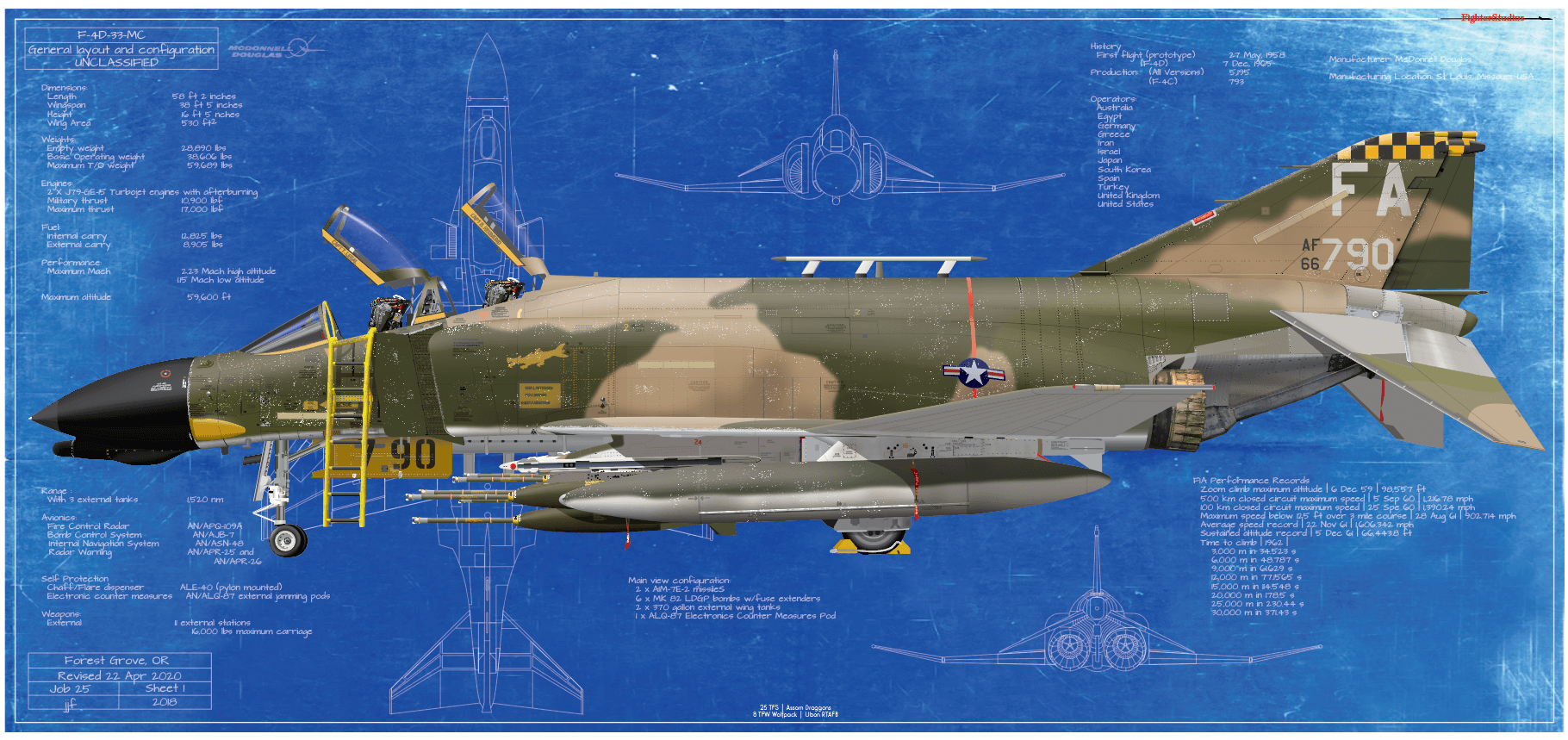
66-8790 flew with the 25 TFS “Assam Dragon” from Ubon RTAFB early in their SEA deployment and later moved to Udorn RTAFB. They were early users of the, then, new F-4D and one of three squadrons in the Vietnam conflict equipped with the AN/ARN-92 LORAN-D navigation system… easily identified by the dorsal “towel rail.”
These jet were updated under the PAVE Phantom program. 66-8970 is shown ready for a strike mission carrying six Mk 82 LDGP bombs each fitted with ‘Daisy Cutter” fuse extenders designed to increase the fragmentation patter by detonating the bomb three feet above the surface. She additionally carries a pair of AIM-7E missiles in the aft fuselage stations, a pair of 370 Gallon external wing tanks on the outboard wing pylons, and an AN/ALQ-101 pod in a forward fuselage station.
Any Fighter Studios print can be customized with different squadron marking, different store configurations, names on the nose or canopy rail. To get yours started, click Personalized Print for more information or click Email with questions.


Images are reduced fidelity for copyright protection.
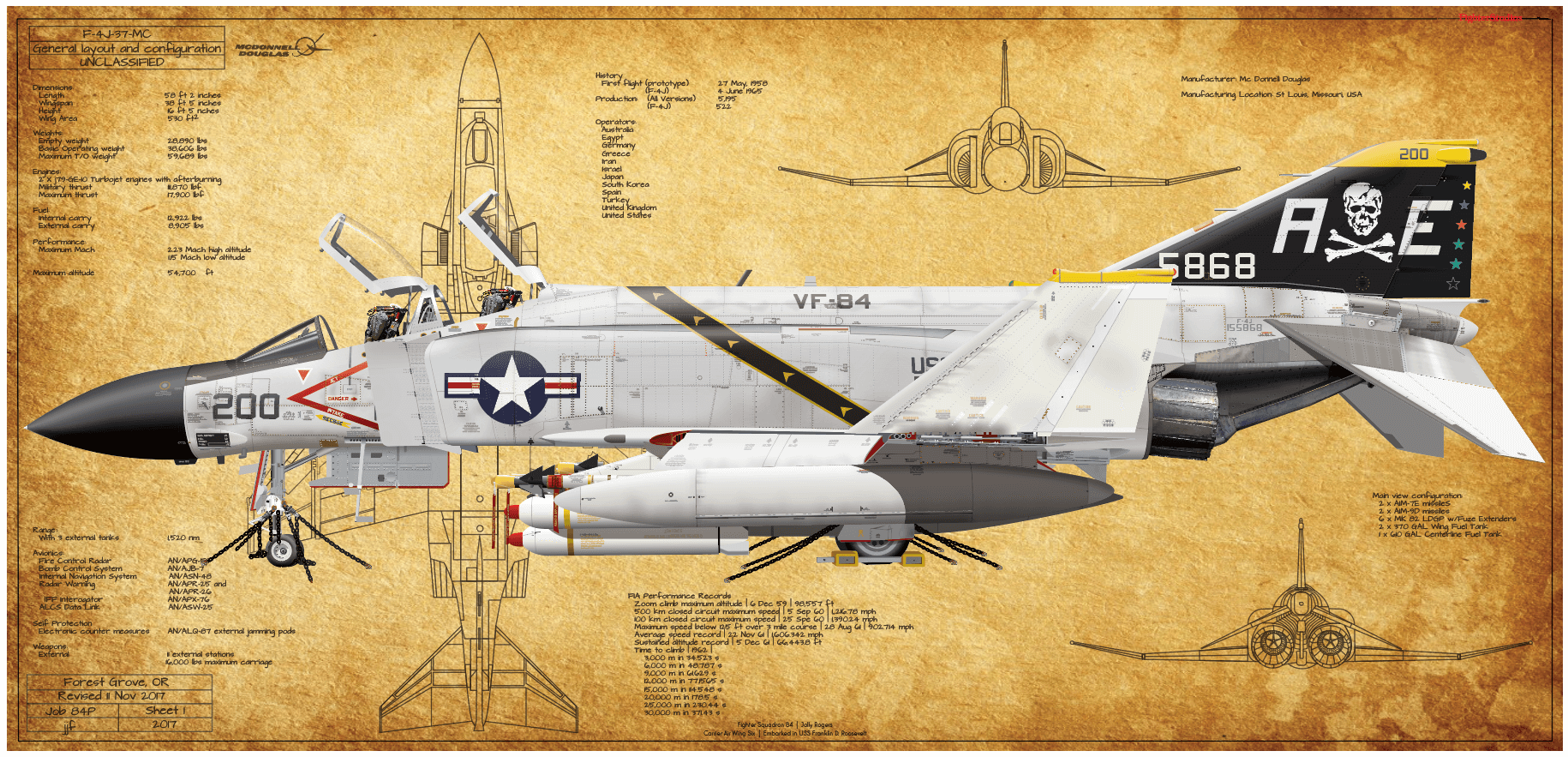
“Fear the Bones” is VF-84’s slogan and while their official nickname is Fighting 84, they are best known as the Jolly Rogers… and the large skull and crossed bones emblem traditionally featured on their jet’s tails makes them one of the USN’s most recognizable fighter squadrons.
This print depicts a F-4J-37-MC from the early 1970’s when VF-84 was assigned to Carrier Air Wing 6. The F-4J was the USN’s last “production” Phantom II although both the F-4N (upgraded F-4B’s) and the F-4S (upgraded F-4J’s) were the last versions flown by the Navy.
The “J” was a significantly upgrade over the F-4B with a beefed-up airframe and the same larger landing gear and tires used by the USAF’s F-4C. Engine thrust was significantly raised with the new J79-10 engines that produced 1,000 lbf per engine more than the -8 engines from the F-4B. Upgraded radar, bombing computer, and other electronics all combined to make the F-4J a much more capable machine than it’s predecessor.
AE 200, as with each “00” plane in the Air Wing, is brightly colored as the “CAG bird.” She is ready on the flight deck, chained down with her wings folded, and loaded with 4 x AIM-9D missiles and 4 x AIM-7E missiles for self-protection and 4 x MK20 Rockeye free fall bombs. She additionally carries a pair or wing tanks and a centerline tank.
Any Fighter Studios print can be customized with different squadron marking, different store configurations, names on the nose or canopy rail. To get yours started, click Personalized Print for more information or click Email with questions.


Images are reduced fidelity for copyright protection.
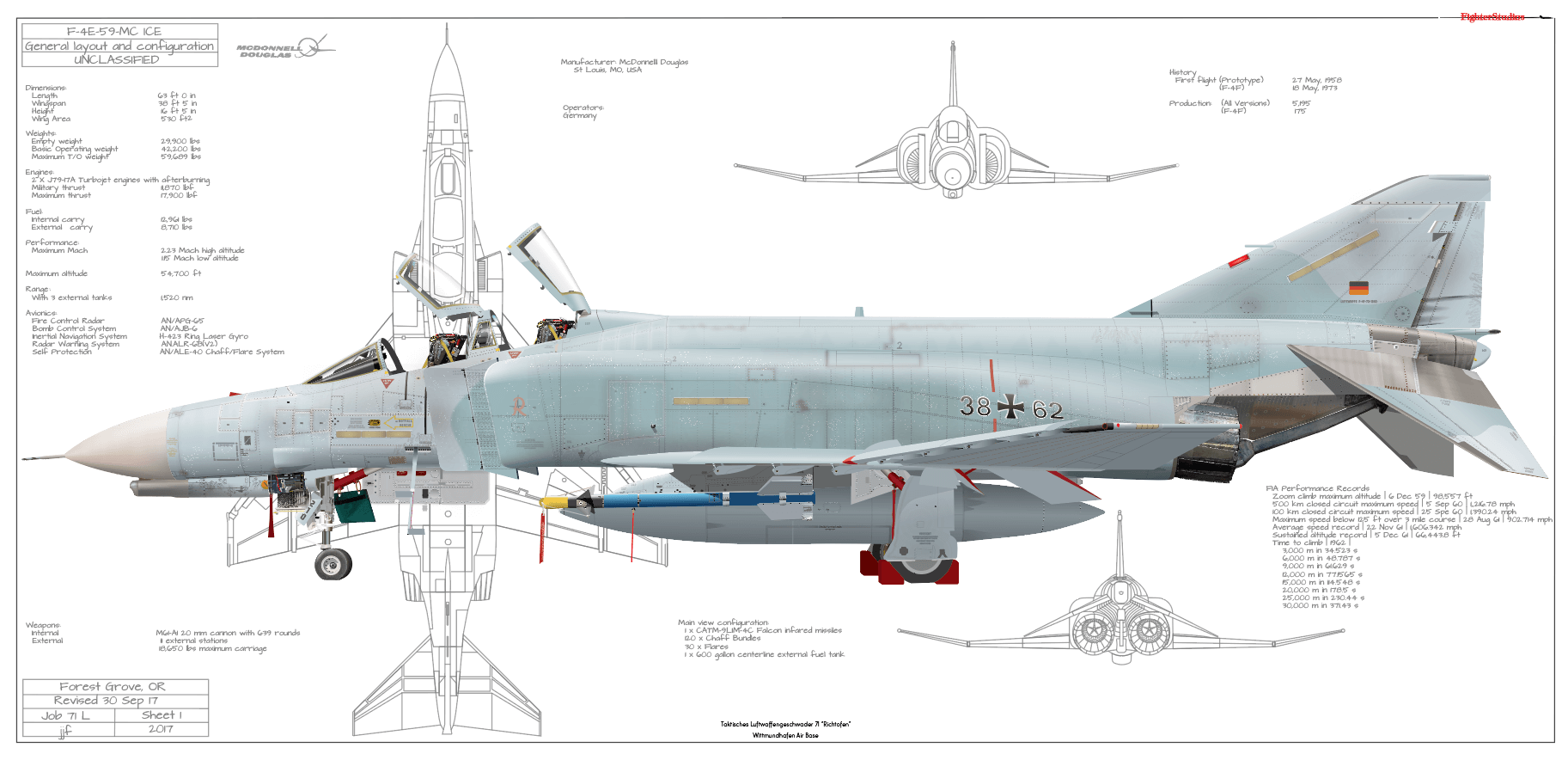
Named for perhaps history’s most famous fighter pilot, Taktisches Luftwaffengeschwader 71 "Richthofen," or the 71 Fighter Wing, has been stationed in northern Germany at Wittmundhafen Air Base since 1693.
In 1974, the began operating a unique version of the Phantom, the F-4F and were tasked with air defense including Zulu Alert. The F-4F began as a lightened version of the F-4E optimized for air-to-air and weighed 11% less than the standard “E.” They were equipped with leading edge slats on the wings but did not use the slotted horizontal stabilizer found on the USAF’s F-4E’s. The “F’s” additionally lacked the F-4E’s 7th internal fuel tank and had no aerial refueling capability.
A major upgrade of the jet began in 1988 and included replacing the original radar with the AN/APG-65 from the F-18 providing not only look-down/shoot-down capability but adding AIM-120 capability. Additionally, a new radar warning system, fire control computer, IFF system, ring-laser inertial navigation system, and air data computer completely revitalized the “F.”
Shown in the “Norm 90J” three-tone grey camouflage worn the Luftwaffe Phantoms at the end of their careers, 38+22 was one of the last operation Luftwaffe Rhino’s. She is depicted ready for an Air-to-Air training mission with a single centerline external tank and a captive carry AIM-9L.
Any Fighter Studios print can be customized with different squadron marking, different store configurations, names on the nose or canopy rail. To get yours started, click Personalized Print for more information or click Email with questions.


Images are reduced fidelity for copyright protection.
Just north of Detroit on the shore of Lake St Clair, Selfridge Air Nation Guard Base was the home for the 171 Fighter Interceptor Squadron’s F-4’s. The Michigan Six Pack provided Air Defense Alert from Selfridge and while deployed both to other CONUS locations as well as overseas locations for twenty years.
Prior to being assigned to the 171st, F-4C-19-MC 63-589 flew with the 8 TFW Wolf Pack and was one of the jets that flew in OPERATION BOLO in which she was credited with MiG 21 victory. She is depicted “cocked” and ready to be scrambled… all normal preflight checks have already been pulled and all non-weapon related safety pins have been removed. The pilot’s helmets are already in the cockpit while the rest nearby already wearing their flight gear.
She is configured with her typical alert load out of 4 x AIM-9E and 4 x AIM-7E missiles and a pair of 370 gallon wing tanks.
Any Fighter Studios print can be customized with different squadron marking, different store configurations, names on the nose or canopy rail. To get yours started, click Personalized Print for more information or click Email with questions.



Images are reduced fidelity for copyright protection.
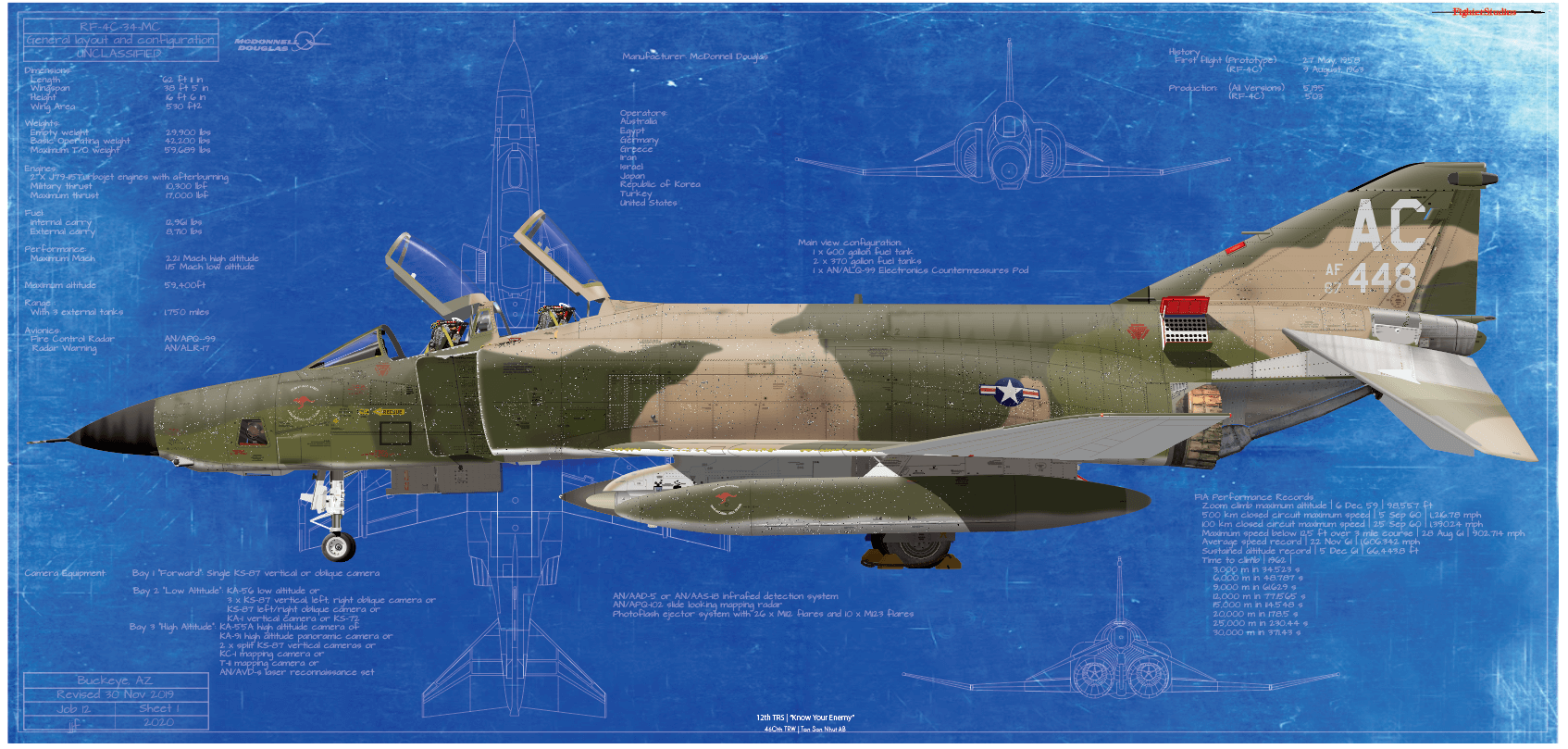
Adapted from the Navy’s RF-4B, the RF-4C enjoy the second longest production run of any Phantom II version with 503 produced. This particular RF-4C was part of the 12 TRS that deployed to Tan Son Nhut AB as part of the 460th TRW.
She is show in her 1968 finish as the jet assigned to pilot SQNLDR Alan Reed RAAF (Kangaroo) and GIB Maj Jim Melton who hailed from Carolina. They completed 100 sorties during their rotation as part of the 26,000 sorties the squadron flew during 5 years at Tan Son Nhut.
Any Fighter Studios print can be customized with different squadron marking, different store configurations, names on the nose or canopy rail. To get yours started, click Personalized Print for more information or click Email with questions.


Images are reduced fidelity for copyright protection.
VF-111 transitioned to the F-4 following numerous deployment to SEA with their F-8's... the "Sundowners" subsequently completed three WESTPAC/Vietnam cruises
This print depicts a F-4B-15-MC from the early 1971/1972 when VF-111 was Embarked in USS Coral Sea as part of CVW-15.
The “B” was the first true production version of the Phantom II. NL 200 is painted with the standard Sundowner scheme except for the multicolored sun "ray" on the tail indicating she is the squadron CAG jet... each color represents one squadron in the Air Wing.
NL 200 is crew ready on the flight deck configured for a close air support mission. She has a 600 gallon centerline tank, 2 x AIM-9D IR missiles and 2 x AIM-7E SAR missiles for self-protection and 6 x high drag MK 82 Snakeye bombs. The Snakeye's spring loaded tail fins expanded upon release if the "tail" fuse was selected enabling the jet to safely escape the bomb's explosion during very low altitude deliveries. That separation allows the pilot to get the required increased precision to deliver bombs in close proximity to friendly troops.
Any Fighter Studios print can be customized with different squadron marking, different store configurations, names on the nose or canopy rail. To get yours started, click Personalized Print for more information or click Email with questions.


Images are reduced fidelity for copyright protection.
The Ghostriders of Fighter Squadron One Four Two deployed seven times during the Vietnam conflict aboard three different aircraft carriers.
NK 210 is shown aboard USS Constellation in the fall of 1968 which was the Ghostrider’s final F-4B deployment before transitioning to the F-4J. Chained to the deck, she is configured with a pair of AIM-9D’s on the pylon rails and a pair of AIM-7E’s in the aft fuselage semi-recessed wells for self defense, six MK 82 SNAKEYE high drag bombs, and a pair of 370 gallon wing tanks.
Any Fighter Studios print can be customized with different squadron marking, different store configurations, names on the nose or canopy rail. To get yours started, click Personalized Print for more information or click Email with questions.


Images are reduced fidelity for copyright protection.
The original JASDF F-4 Phantom II squadron, 301 Sq has flown both the F-4EJ and F-4EJ Kai from Hyakuri northeast of Tokyo and Nyutabaru Air Bases on the southern Island of Kyushu. The F-4EJ version is unique to Japan’s Air Force and was primarily built in Japan by Mitsubishi Heavy Industries. Unlike the US F-4E, it was a “hard wing” Rhino lacking slats on the wings and stab. It additionally, originally, lacked inflight refueling capability and air-to-surface weapons capability. It also featured some domestic Japanese hardware like RHAW equipment and a datalink to interface with ground air defense units.
While stationed at Nyutabaru, the squadron celebrated its 30 anniversary by painting 07-8345 with a very cool rising sun motif covering the entire intake on both flanks, a shark mouth nose graphic and a black, blue, striped across the upper surfaces from the radome to the tail.
She is shown with a clean configuration for an air-to-air training sortie carrying only a CATM-9L infrared missile and chaff/flare expendables.
Any Fighter Studios print can be customized with different squadron marking, different store configurations, names on the nose or canopy rail. To get yours started, click Personalized Print for more information or click Email with questions.


Images are reduced fidelity for copyright protection.
The first supersonic gun kill in aviation history occurred on 2 Jun 72 during the Vietnam conflict. In the early afternoon, Brenda flight, led by Maj Phil “Hands” Handley, was performing a CAP for a SAR mission northeast of Hanoi. While egressing because of Brenda 2’s fuel state, Brenda 01 spotted and engaged a MiG 19. After jettisoning his remaining external tanks, Hands tried to engage the MiG with both AIM-7E missiles on the jet… one failed to ignite and the other failed to guide. May Handley switch to the AIM-4 infrared missiles and fired two… both of which missed the target. After maneuvering to keep the target in sight and maintain nose-tail separation, Hands pulled down inside the bandit’s turn circle, established lead while settling into the target’s plane of motion, and pulled the trigger to fire the 20 mm cannon. With Brenda 01 traveling at approximately Mach 1.2 at less than 1,000 ft AGL, the MiG failed to perform any out of plane guns defense and flew directly in front of Hands at about 300 ft slant range and 90 degrees heading crossing angles. The MiG immediately began trailing fire and smoke and impacted the ground shortly after.
Brenda 01 is depicted with her AIM-7, AIM-4 loadout as well as her three external tanks. She carries an AN/ALQ-87 ECM pod in the forward, port AIM-7 missile well.
Any Fighter Studios print can be customized with different squadron marking, different store configurations, names on the nose or canopy rail. To get yours started, click Personalized Print for more information or click Email with questions.


Images are reduced fidelity for copyright protection.
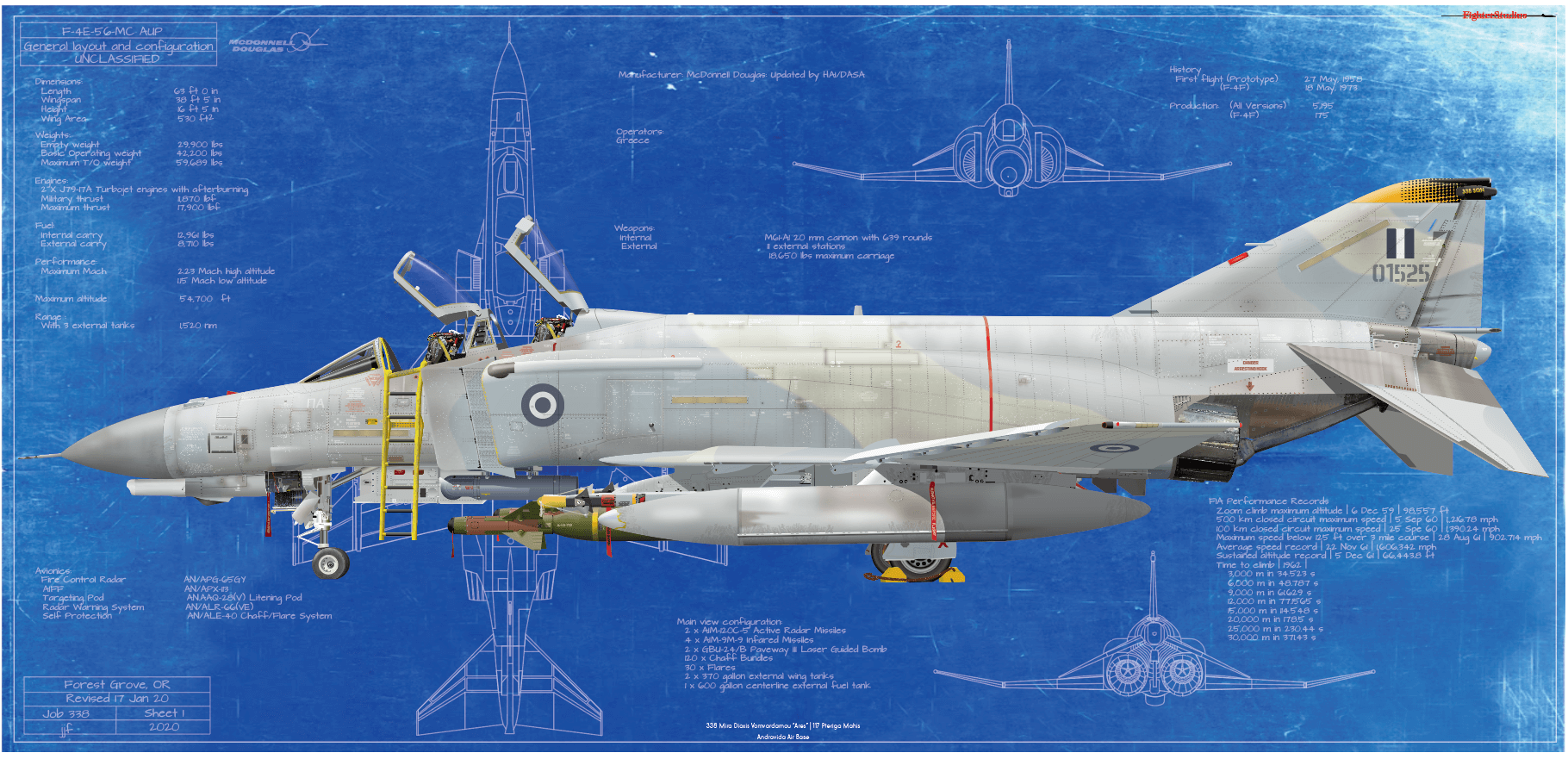
Greece's Air Force, the Hellenic Air Force, began operating F-4's in the mid-1970's with an Air-to-Air squadron and an Air-to-Ground Squadron... 338 Squadron “Ares,” based at Andravida Air Base on Greece's western coast. The last HAF F-4E Squadron, they currently fly the F-4E AUP... an abbreviation for Avionics Upgrade Program. AUP is also known as Peace Icarus 2000.
The AUP jets received new fire control radars, a new airborne IFF interrogator, new central air data and modular multi-role computers, a laser gyro INS with embedded GPS, a HUD, and color multifunction displays in both cockpits. They are AIM-120 capable and can carry a variety of new air-to-surface weapons.
01525 is shown in the latest "Aegean Ghost" camouflage paint scheme ready for a precision strike sortie with a pair of GBU-23 Paveway III laser guided bombs. For self-protection, she carries a pair of AIM-120 AMRAAM missiles in the aft fuselage missile wells, four AIM-9M Sidewinder missiles, her internal 20 mm Vulcan cannon, and a full complement of expendables. For targeting and to laser designate desired impact points, she carries a Litening pod in the forward, port missile well as well as external fuel tanks.
Any Fighter Studios print can be customized with different squadron marking, different store configurations, names on the nose or canopy rail. To get yours started, click Personalized Print for more information or click Email with questions.


Images are reduced fidelity for copyright protection.
In Israeli service, the F-4 is known as the “Kurnass” which is Hebrew for “heavy hammer” or “sledgehammer…” an apropos name for the beast that is the Phantom.
This specific Kurnass is the updated Kurnaas 2000 version which was a combined effort of Germany’s DASA and local Israeli IAI. Improved computers, cockpit head’s up and head’s down displays, a new fire control radar, and airframe strengthening changed the jet into a very different machine. Additional weapon capability, like the Rafael Popeye missile in the print, were also added. 630 flew with the 201 Squadron, known as “The One” and is shown ready for a Popeye PGM mission with a missile on the near and ASX-1 targeting system on the far side.
She also carries a self defense AIM-9M and three external fuel tanks.
Any Fighter Studios print can be customized with different squadron marking, different store configurations, names on the nose or canopy rail. To get yours started, click Personalized Print for more information or click Email with questions.


Images are reduced fidelity for copyright protection.
Flying with the callsign “Felix,” VF 31’s Tomcatters are the USN’s second oldest Fighter Squadron. Giving up their F3H Demons, the transitioned to the F-4B in 1962.
AC 105 is shown configured for a MIG SWEEP mission with a full load of 4 x AIM-7E’s semi-submerged under the fuselage and 4 x AIM-9D’s on her inboard underwing pylons plus a 600-gallon centerline tank.
Any Fighter Studios print can be customized with different squadron marking, different store configurations, names on the nose or canopy rail. To get yours started, click Personalized Print for more information or click Email with questions.


Images are reduced fidelity for copyright protection.
When FITRON THIRTYONE’s Tomcatters traded their F-4B’s for the much improved F-4J’s, they joined the colorful unit markings that pervaded Naval Aviation in the 1970’s. With a bright red tail and arrow on the spine, AC 106 proudly wears the unit’s bomb wielding Felix the cat patch on her intake.
She is configured for a MIGCAP mission with a full load of 4 x AIM-7E’s and AIM-9G’s plus three external wing tanks. On 21 June, 1972, as the conflict was in it’s final year, 157307 would score CF 31’s only MiG kill when CDR Sam Flynn and Lt William John shot down a MiG 21 with an AIM-9.
Any Fighter Studios print can be customized with different squadron marking, different store configurations, names on the nose or canopy rail. To get yours started, click Personalized Print for more information or click Email with questions.


Images are reduced fidelity for copyright protection.
For 19 years, the Swordsmen of Fighter Squadron 32 flew the F-4 Phantom II out of NAS Oceana and embarked in USS Franklin D. Roosevelt and USS John F. Kennedy’s first cruise.
AB 214 is shown during workups for that final cruise loaded with a centerline 600-gallon tank and empty AIM-9 rails.
Any Fighter Studios print can be customized with different squadron marking, different store configurations, names on the nose or canopy rail. To get yours started, click Personalized Print for more information or click Email with questions.


Images are reduced fidelity for copyright protection.
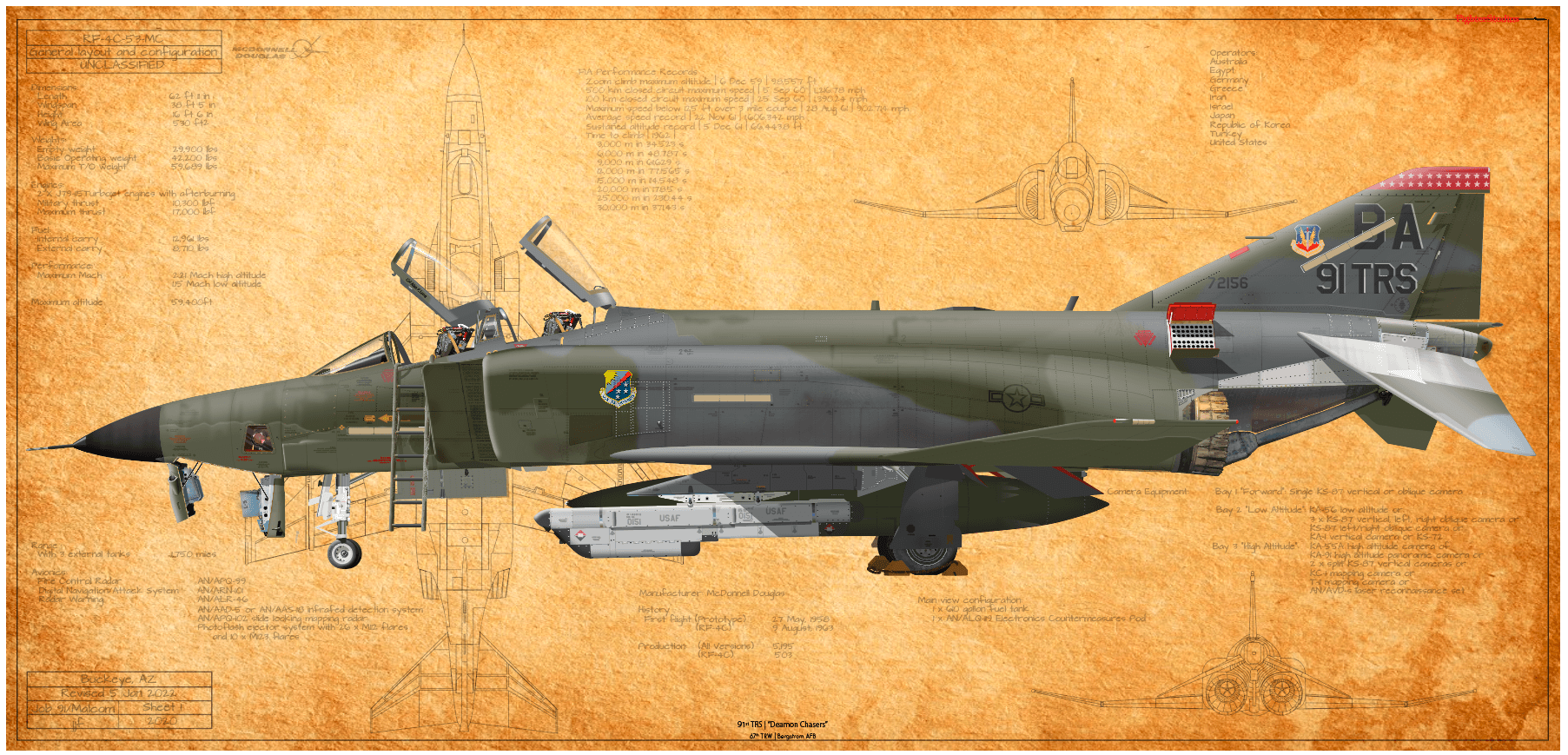
72-0156 is the last production RF-4C produced for the USAF. She featured the updated "smooth nose" camera bay which offered move volume than the original "chisel nose" version.
She is show in in the late 1980's as the Demon Chaser's flag ship and is covered in that time frame's "European One" wrap around camo scheme in which the tan of the Vietnam era's camo was replaced with a dark grey.
Any Fighter Studios print can be customized with different squadron marking, different store configurations, names on the nose or canopy rail. To get yours started, click Personalized Print for more information or click Email with questions.


Images are reduced fidelity for copyright protection.
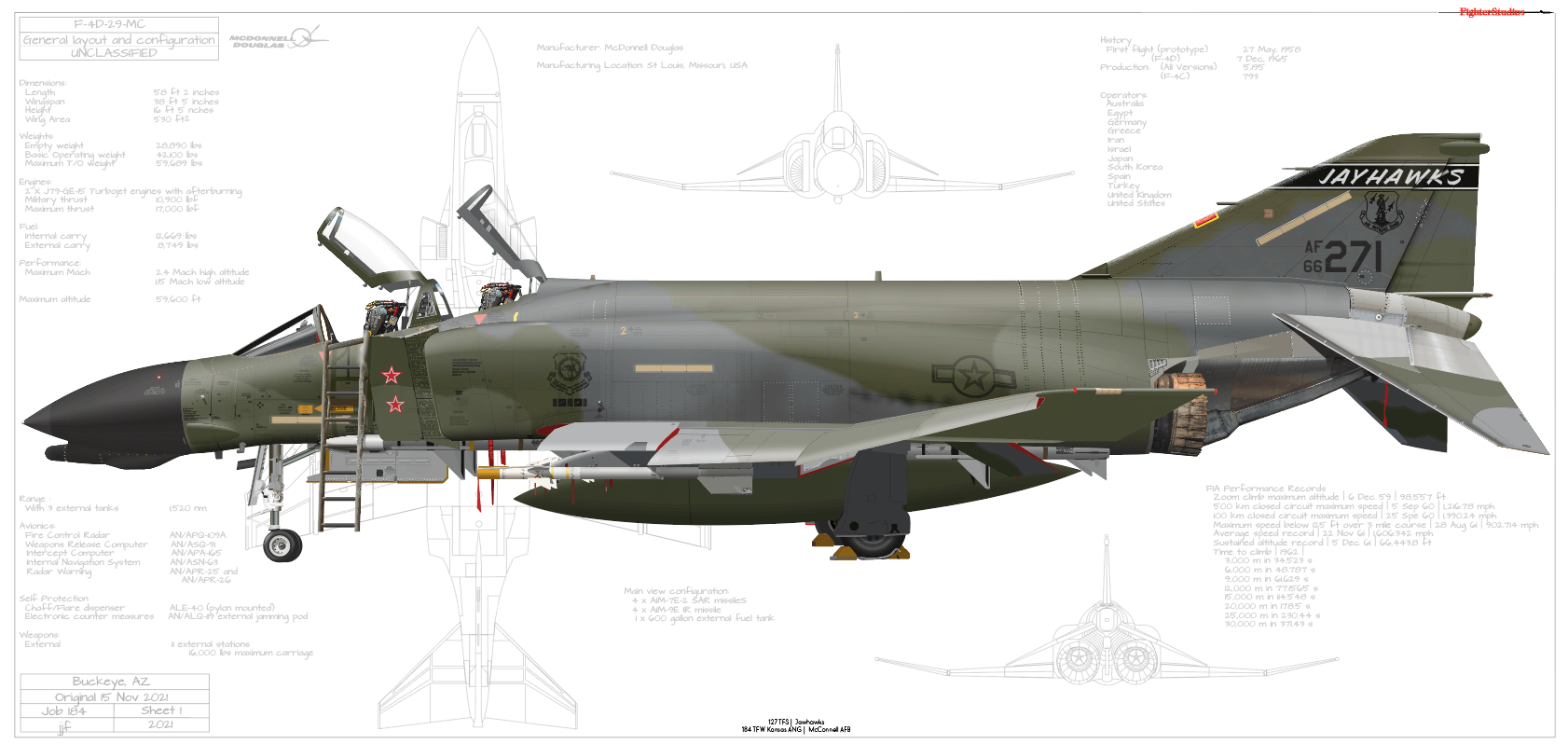
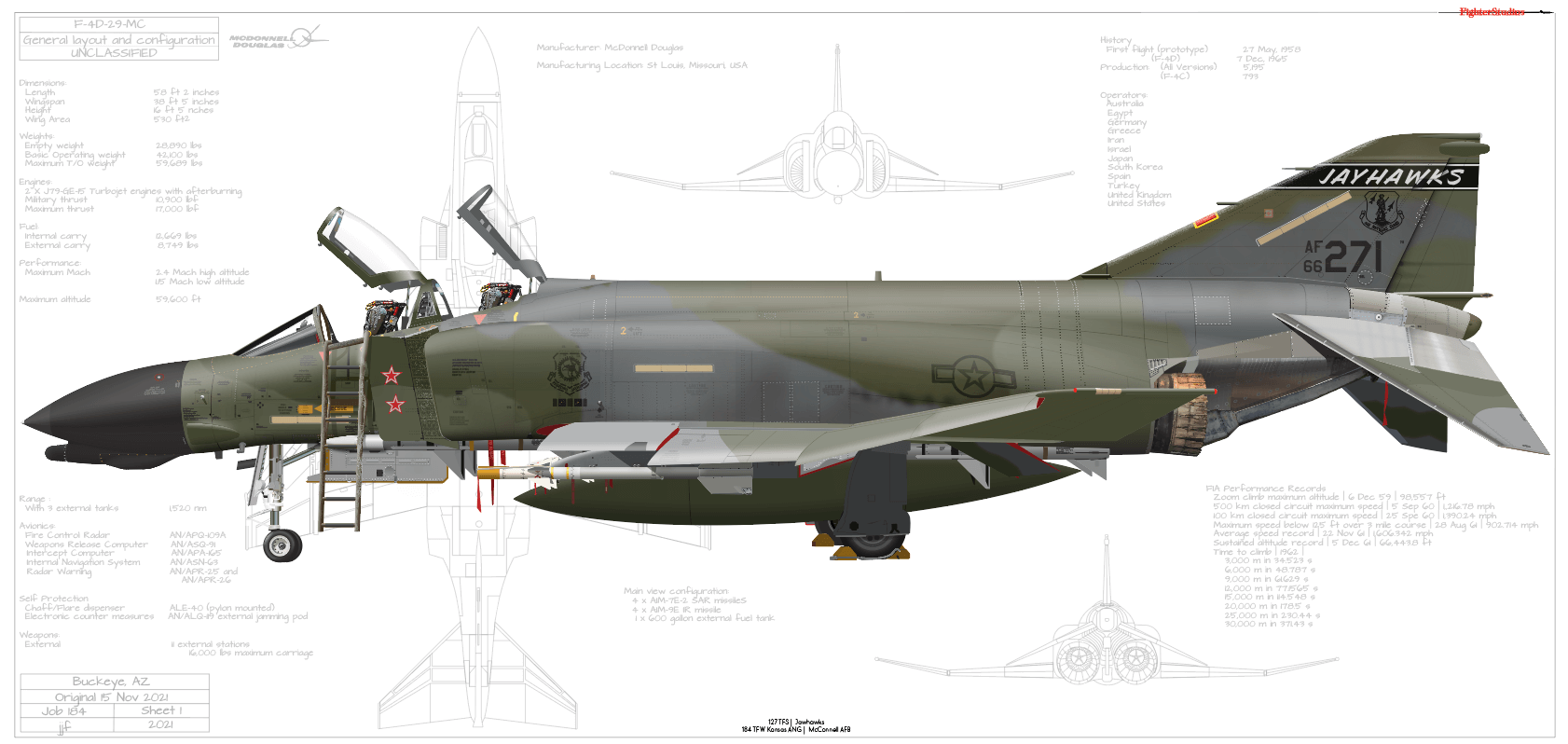
The Kansas ANG’s 127 TFS Jayhawks replaced their F-105’s with F-4D’s in 1982 and was responsible for providing the F-4 Fighter Weapons Instructor course for active duty and AFRES aircrews.
Wearing her green/grey “European One” camouflage, 66-271 still carries the MiG kill markings from her Vietnam conflict days… she scored an AIM-7 and an AIM-9 victories over a pair of MiG 21’s in July 1972.
Configured for an Air Superiority sortie, 271 is loaded with 4 x AIM-7E’s, 4 x AIM-9E’s, and a 600-Gallon centerline fuel tank.
Any Fighter Studios print can be customized with different squadron marking, different store configurations, names on the nose or canopy rail. To get yours started, click Personalized Print for more information or click Email with questions.


Images are reduced fidelity for copyright protection.
The Flying Knights trace their origins to just before WW2 and have flown P35’s, P-40’s P-47’s, P-38’s, P-51’s, P/F-80’s, F-84’s, F-100’s F-105’s, F-4’sD/F’s, F-15’s, and F-117’s at bases around the world. Today they are a MQ-9 Reaper squadron at Holloman AFB. For just over a decade between 1967 and 1978, their mount was the F-4D.
One of those Phantom’s was F-4D-29-MC 66-0519. She is shown configured for an Air Superiority sortie, 271 is loaded with 4 x AIM-7E’s, 4 x AIM-9E’s, and a 600-Gallon centerline fuel tank. Unusually, she also lacks the under nose IRST pod.
Any Fighter Studios print can be customized with different squadron marking, different store configurations, names on the nose or canopy rail. To get yours started, click Personalized Print for more information or click Email with questions.


Images are reduced fidelity for copyright protection.
Tracing its routes to the early days of WW2 as a B-17 heavy bomber unit, the 562 TFS transitioned to the fighter world in 1953. Flying F-86’s and F-100’s during the cold war years, they began operating the F-105D in 1962 and by 1965 they were flying sorties in Vietnam.
In 1974, began life as a tactical training unit in the SEAD mission with the F-105G and continued as they transitioned to the F-4G in 1980. They continued that mission at California’s George AFB for 12 years.
Shown in the late wrap around two tone grey camouflage adopted by the USAF F-4’s in the late 1980’s 69-0272 is ready for an air-to-air sortie with a single CATM-9L missile and a 600-gallon centerline tank.
Any Fighter Studios print can be customized with different squadron marking, different store configurations, names on the nose or canopy rail. To get yours started, click Personalized Print for more information or click Email with questions.


Images are reduced fidelity for copyright protection.
In 1968, the 526 TFS “Black Knights” converted from the F102 Delta Dagger to the new F-4E Phantom II while stationed at Ramstein AB Germany.
The squadron jet, 68-0526, is shown shortly after arrival ready for an air-to-air training sortie with a CATM-9J training missile and a centerline 600 gallon external tank. She still carries the original muzzle faring for her internal 20 mm cannon which was replaced no long after with an updated version because of gun gas issues with the first design.
Any Fighter Studios print can be customized with different squadron marking, different store configurations, names on the nose or canopy rail. To get yours started, click Personalized Print for more information or click Email with questions.
Images are reduced fidelity for copyright protection.
The Flying Knights trace their origins to just before WW2 and have flown P35’s, P-40’s P-47’s, P-38’s, P-51’s, P/F-80’s, F-84’s, F-100’s F-105’s, F-4’sD/F’s, F-15’s, and F-117’s at bases around the world. Today they are a MQ-9 Reaper squadron at Holloman AFB. For just over a decade between 1967 and 1978, their mount was the F-4D.
One of those Phantom’s was F-4D-29-MC 66-0519. She is shown configured for an Air Superiority sortie, 271 is loaded with 4 x AIM-7E’s, 4 x AIM-9E’s, and a 600-Gallon centerline fuel tank. Unusually, she also lacks the under nose IRST pod.
Any Fighter Studios print can be customized with different squadron marking, different store configurations, names on the nose or canopy rail. To get yours started, click Personalized Print for more information or click Email with questions.
Images are reduced fidelity for copyright protection.
Tracing its routes to the early days of WW2 as a B-17 heavy bomber unit, the 562 TFS transitioned to the fighter world in 1953. Flying F-86’s and F-100’s during the cold war years, they began operating the F-105D in 1962 and by 1965 they were flying sorties in Vietnam.
In 1974, began life as a tactical training unit in the SEAD mission with the F-105G and continued as they transitioned to the F-4G in 1980. They continued that mission at California’s George AFB for 12 years.
Shown in the late wrap around two tone grey camouflage adopted by the USAF F-4’s in the late 1980’s 69-0272 is ready for an air-to-air sortie with a single CATM-9L missile and a 600-gallon centerline tank.
Any Fighter Studios print can be customized with different squadron marking, different store configurations, names on the nose or canopy rail. To get yours started, click Personalized Print for more information or click Email with questions.

Images are reduced fidelity for copyright protection.
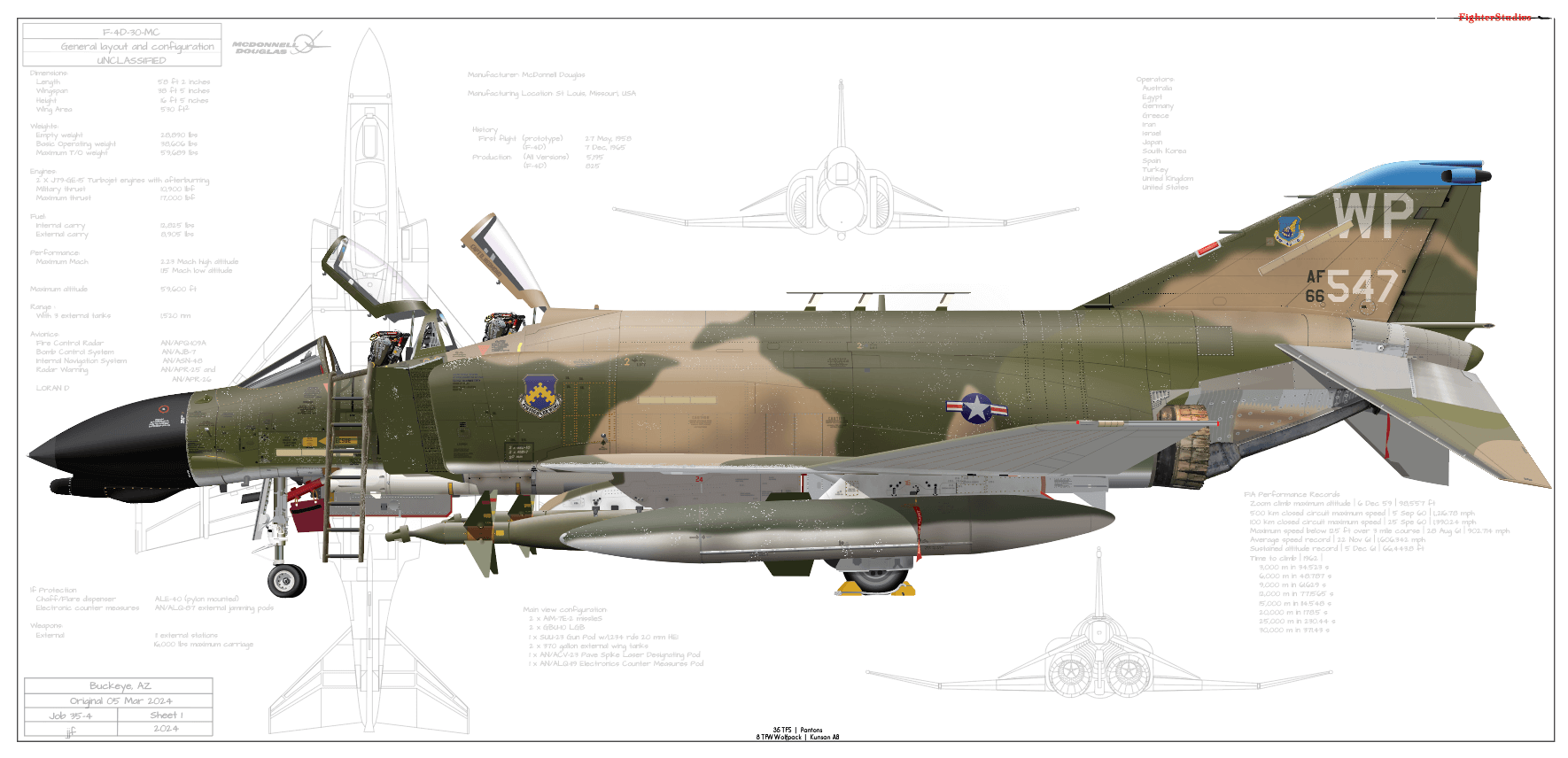
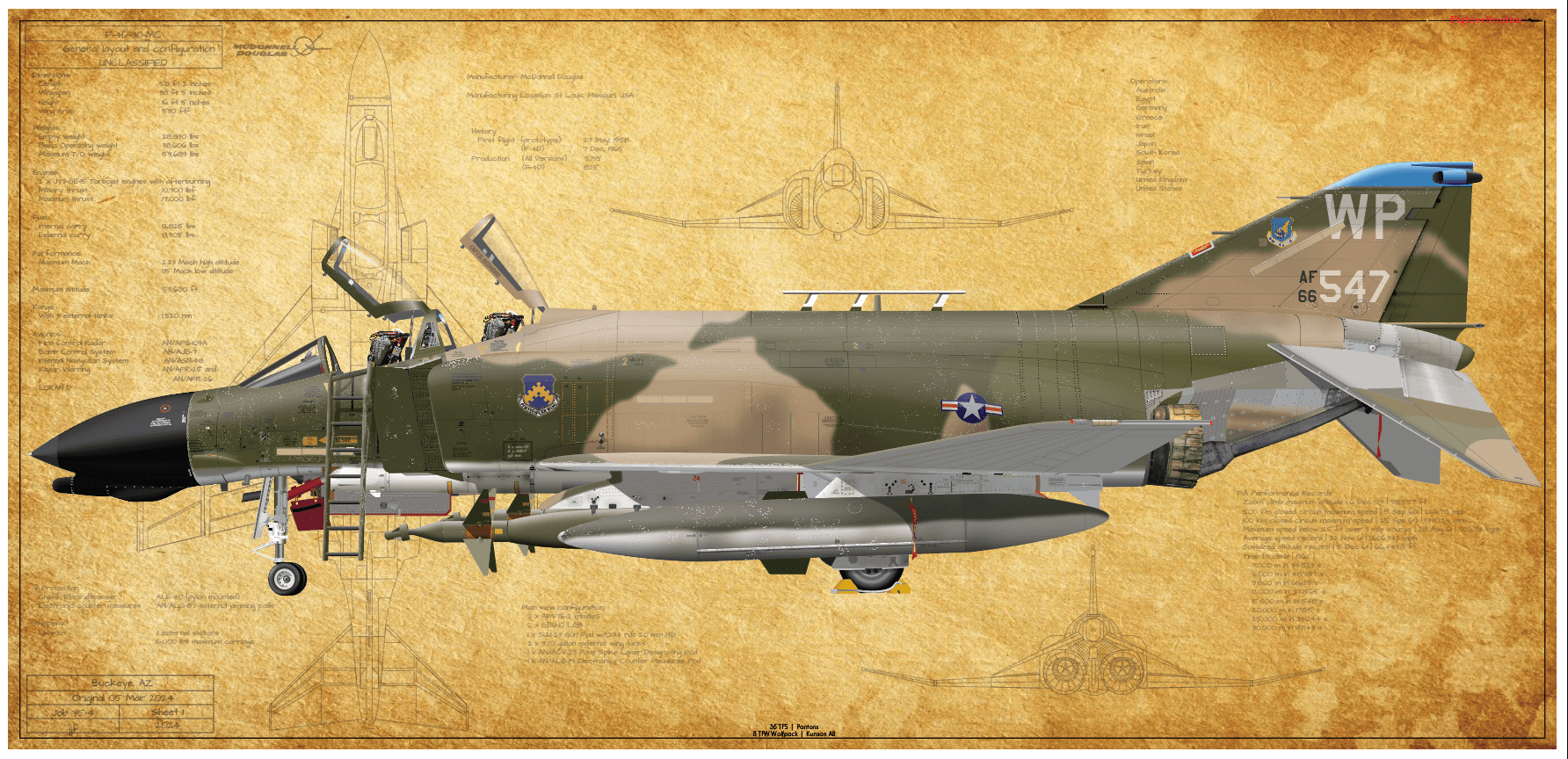
Following an eight year deployment for the Vietnam conflict, the 35 TFS Pantons moved to Korea's Kunsan AB along with their sister squadron where they remain today. At that time, as depicted, they operated AN/ARN -92 LORAN-D equipped as evidenced by the system's "towel rack" antenna on the jet's spine.
66-0547 is show with a standard PGM load out of a pair of early GBU-10 2,000 lb Paveway "large fin" bombs and a pair of AIM-7E's loaded in the aft fuselage wells. To locate the targets and provide laser designation, she carries AN/AQV-23 Pave Spike targeting pod in the forward port fuselage missile well and an AN/ALQ-119 electronics pod for self-protection on the opposite side. On the centerline station, she has a SUU-23 20mm gun pod and carries a pair of 370 gallon wing tanks.
Any Fighter Studios print can be customized with different squadron marking, different store configurations, names on the nose or canopy rail. To get yours started, click Personalized Print for more information or click Email with questions.